
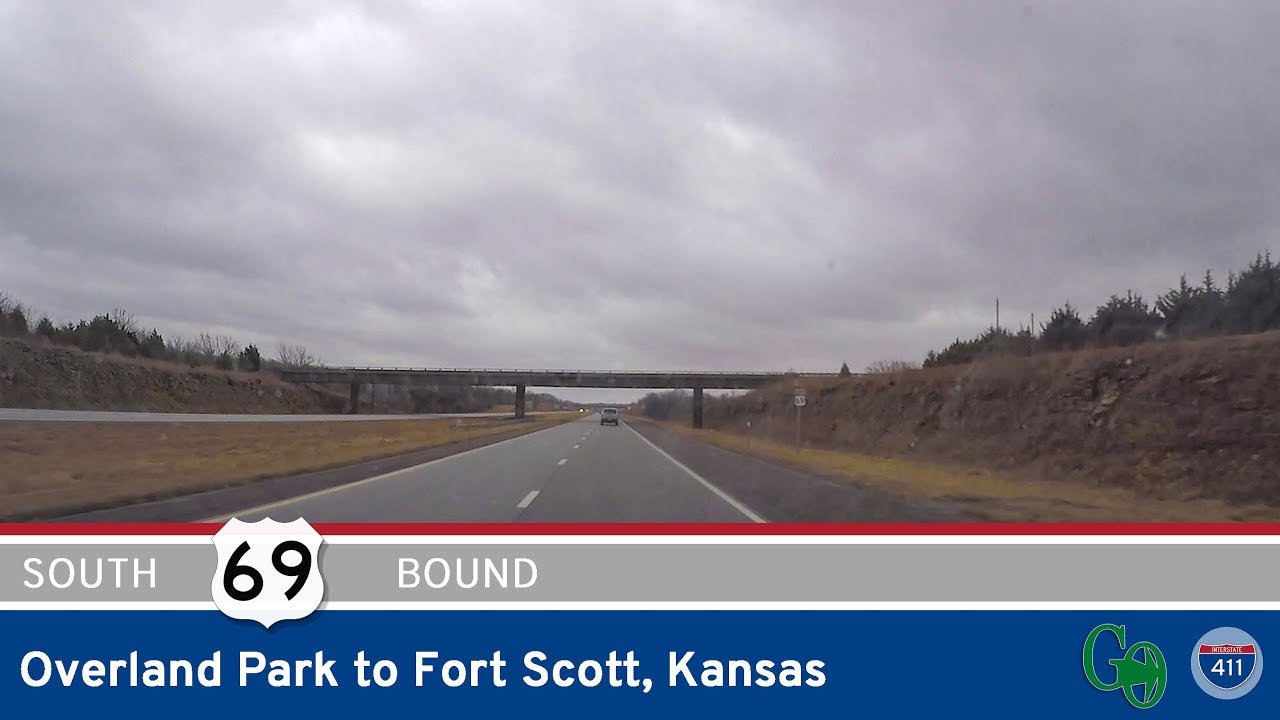
Take a drive through the southeast corner of Kansas as we follow a quiet but important stretch of U.S. Highway 69 from Fort Scott to Franklin. This 23-mile route runs straight through the Flint Hills borderland and coal country, threading between agricultural landscapes, bypassed small towns, and the echoes of the region’s mining past. Though modern in alignment, this highway hums with history and purpose, guiding travelers south from Fort Scott toward the heart of Crawford County.
Our journey begins in Fort Scott, a city with deep military roots and a well-preserved historic district centered around the 1842 Fort Scott National Historic Site. We pick up U.S. 69 at its junction with U.S. 54, near the southern edge of downtown, where stately brick buildings and shaded neighborhoods begin to give way to a more commercial corridor. As we head south, the road briefly clings to its older urban character before reaching the interchange with Kansas Highway 7. Here, U.S. 69 becomes a divided four-lane expressway—one of the main north-south routes through eastern Kansas—and quickly accelerates into open country. We leave Fort Scott behind as fields stretch outward, alternating between pastureland and row crops, dotted with occasional grain bins and working farmsteads.
South of the Dry Wood Creek valley and its namesake rural community, we continue across gentle terrain and low ridges shaped by centuries of water and wind. The landscape here feels broader, more expansive—hints of prairie and pasture returning where forest once thickened around the old coalfields. This area, part of the Cherokee Lowlands, once buzzed with the activity of strip mines and company towns. Today, that energy has quieted, replaced by new uses: some reclaimed land is now wildlife habitat, while other stretches support hayfields and cattle grazing. The highway flows smoothly, with only the occasional overpass or county road junction to interrupt the rhythm.
We pass just west of Arma, a small town founded in the early 1900s as a coal camp. The expressway alignment curves subtly to avoid the heart of town, a modern bypass that keeps through-traffic moving efficiently while leaving Arma’s grid of homes and local streets intact. As we continue south, the road gently descends into a shallower grade—less hilly now, with broad views and fewer interruptions. Utility lines track our progress, following the right-of-way like sentinels. The wind here is often steady, hinting at the proximity of the open plains farther north and west.
Our drive concludes at the intersection with Kansas Highway 47 in the unincorporated community of Franklin. Though small, Franklin holds a powerful place in Kansas labor history: it was the site of early organizing efforts during the peak of the region’s mining era. A local museum and memorial to area miners reflect the pride and struggle of those who helped build southeast Kansas. Today, U.S. 69 continues farther south toward Pittsburg and the Oklahoma border, but here in Franklin, we pause—reminded that even a seemingly ordinary stretch of highway can connect us not only to place, but to legacy.
🗺️ Route Map
0 Comments